

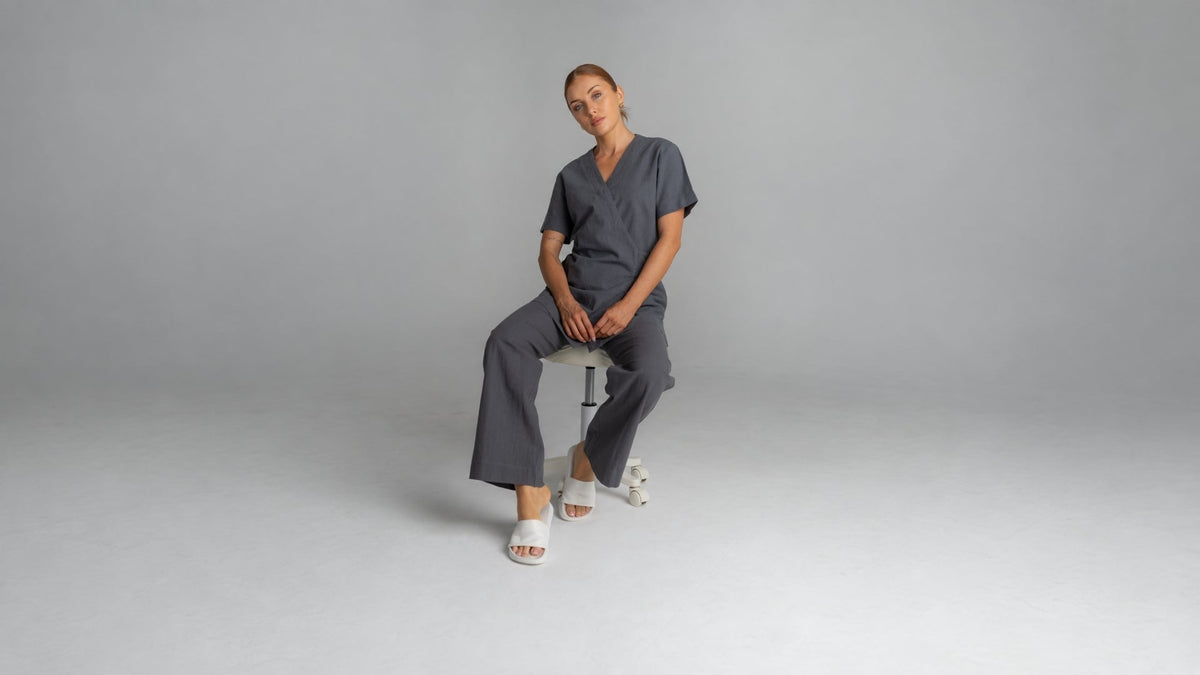
We believe a uniform should disappear while you work. Massage is the hardest test of that, an hour of continuous physical effort in a deliberately warm room, arms extended and raised, with oil on your hands the entire time. Nothing can drag across a client, nothing can bind at the shoulder, and nothing can hold heat against you. So we cut sleeveless styles with full shoulder freedom, in fabrics that breathe properly, and we make the treatment bed linen that goes with them. Tailored, sizes 4 to 26.
In this article
- What does massage demand that other treatments do not?
- Why do most massage therapists wear sleeveless?
- How do you stay cool in a treatment room?
- What happens to a uniform that meets oil every day?
- What linen does a massage room need?
- Which styles suit massage work?
- Questions we're often asked
What does massage demand that other treatments do not?
Sustained physical effort, in heat, for an hour without a break.
A facial has pauses, a mask on, a lamp, a moment to prepare the next step. A massage does not. From the first stroke to the last you are moving continuously, using your body weight, working at a range of heights from the head end to the feet.
Three consequences follow.
You generate heat. More than in any other treatment, in a room deliberately kept warm for the client. Whatever you are wearing has to move that heat away or you will feel it within twenty minutes.
Your arms are extended and raised constantly. Reaching down the length of a body, working over the shoulders, effleurage from the head end. Any restriction at the shoulder becomes exhausting rather than merely annoying.
Nothing can touch the client. A sleeve that drags across skin mid-stroke breaks the treatment. This is the reason sleeveless dominates in massage where it is a minority choice elsewhere.
Add mobile work, and a large share of massage in Australia is mobile, and a uniform also has to survive being packed, transported and worn without a mirror.
Why do most massage therapists wear sleeveless?
Because it solves the two biggest problems at once, heat and contact.
A sleeveless tunic gives complete freedom through the shoulder and removes any risk of fabric brushing a client during a stroke. It also vents heat where you generate most of it.
The trade is coverage, and that is genuinely personal. Some therapists are not comfortable working with bare arms, and a uniform someone feels self-conscious in is one they will avoid. If you are outfitting a team, offer a sleeve option within the same style and colour, so the silhouette stays consistent and everyone is comfortable.
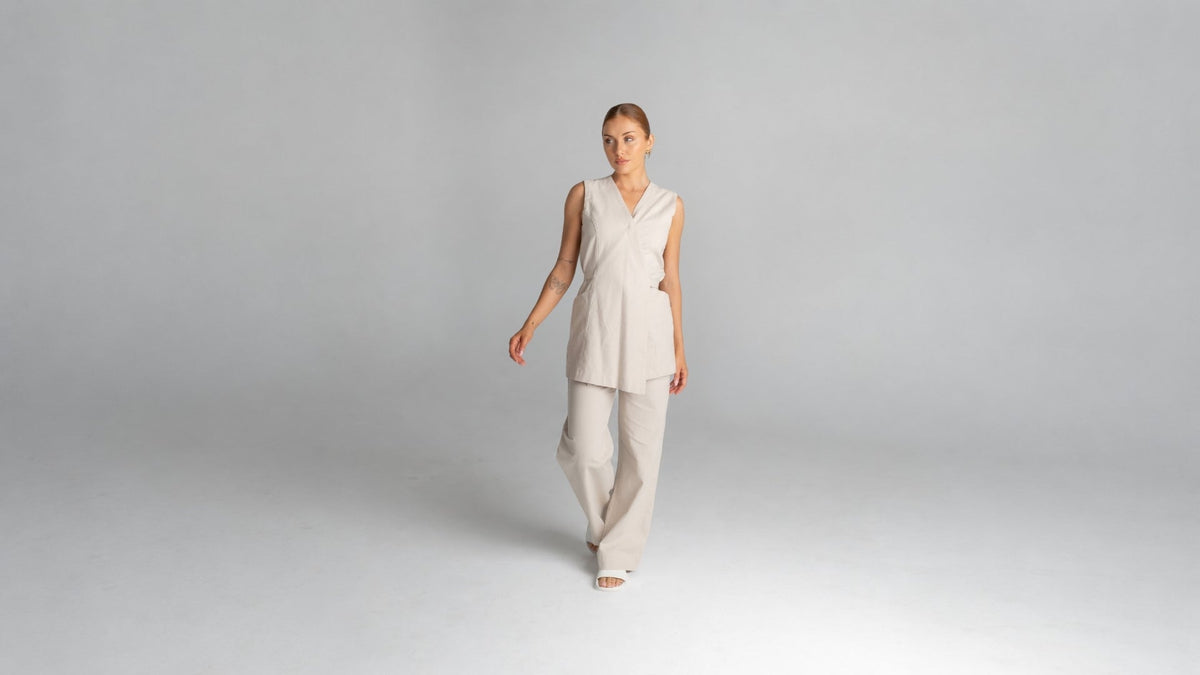
The Fleur Linen Tunic is the style we see most often on massage therapists. Sleeveless, in organic linen-cotton, with split sides for movement. The Spa Uniform 17 is the performance-fabric equivalent for anyone who prefers a synthetic blend.
How do you stay cool in a treatment room?
Fabric does most of it, and this is where the choice genuinely matters.
Organic linen-cotton is the best answer for massage specifically. Flax fibre is hollow, so air moves through the weave and moisture moves out of it rather than sitting against your skin. Linen has been worn in hot climates for thousands of years for exactly this reason.
This is where the distinction between real linen and faux linen stops being academic. Faux linen is polyester woven to look like flax, so it traps heat and moisture rather than moving them. In a warm massage room, over an hour of physical work, you will notice the difference within one treatment. Ours is the only organic linen-cotton uniform range in Australia, and every other range on the market is faux.
A performance blend works well too, provided it is a genuine four-way stretch with a breathable construction rather than a heavy polyester.
What to avoid. Anything heavy, anything with a lining, and anything that fits closely across the back.
Beyond fabric, two practical things. Keep the room warm for the client but ventilate between appointments, and keep a spare uniform if you run several massages back to back.
What happens to a uniform that meets oil every day?
Oil is absorbed rather than sitting on the surface, which is why oil marks appear after washing rather than at the time. It is also why a uniform can look fine at the end of a shift and disappointing the next morning.
Three things help.
Treat it cold and immediately. Never warm water, because heat helps oil bond to fibre. Blot rather than rub.
Wear an apron for anything heavy. Body treatments, clay, exfoliation and hot stone all send more product at you than a standard massage. A linen apron costs a fraction of a tunic and takes the contact.
Wash uniforms separately from towels and sheets. Towelling sheds lint that works into the weave and pills, which is the most common reason a massage therapist's uniform looks tired early, and massage generates more towel laundry than any other treatment.
The full care routine is in what actually ruins a uniform.
What linen does a massage room need?
This is the half of the job most massage therapists underestimate, particularly when starting out or working mobile.
Treatment beds and massage tables are different shapes. A massage table is narrower, often portable, and usually open underneath. A treatment bed is wider, taller and has a base running to the floor. Most linen sold in Australia as spa bedding was cut for a table, which is why it sits short and pulls at the corners on a bed.
Ours is cut for treatment beds. A room needs five things.
Fitted sheets, and a face-hole version for prone work, meaning a proper opening rather than a gap the client has to arrange around.
Flat sheets to cover the client.
A bed cover that takes the oil and is quick to change between appointments.
Face cradle covers, in twos, because you will always want a spare.
A valance to skirt the base, which is the single change that most improves how a room looks.
All of it is microfibre, which dries in about seven minutes. In a clinic turning linen over between clients, that number matters more than anything else on the spec sheet. Plan on two to three complete sets per bed.
The full detail is in why most spa bedding is really just massage table linen.
Which styles suit massage work?
Everything is in Massage Therapist Uniforms & Supplies, uniforms and linen together.
Fleur Linen Tunic, sleeveless, organic linen-cotton, split sides. The most popular massage style we make.
Spa Uniform 17, a sleeveless wrap in performance fabric, with two front pockets.
Eden Linen Tunic, short sleeve, for therapists who want coverage without heat.
Bottoms. Willow Linen Pants to match a linen tunic, Linen Jogger Pants for a softer line, or Capri Pants through summer.
If you work mobile, why mobile therapists need more from a uniform covers what changes when your treatment room lives in a car.
Questions we're often asked
What do massage therapists wear to work?
Most massage therapists wear a sleeveless or short-sleeve tunic with relaxed pants, chosen for shoulder freedom and breathability. Sleeveless is the most common choice because it prevents fabric dragging across a client mid-stroke and vents the heat generated by an hour of continuous physical work.
What is the best fabric for a massage uniform?
Organic linen-cotton is the best choice for massage specifically, because hollow flax fibre moves air and moisture away from the skin in a warm treatment room. Faux linen is polyester and traps both. A genuine four-way stretch performance blend also works if you prefer a synthetic.
Why do massage therapists wear sleeveless tops?
Two reasons. Sleeves can drag across a client's skin during a stroke, which breaks the treatment. And massage generates more body heat than any other treatment, in a room kept deliberately warm, so venting at the shoulder matters. Coverage remains a personal preference.
How do you get massage oil out of a uniform?
Treat it immediately with cold water and blot rather than rub, because warm water helps oil bond to the fibre. Oil is absorbed rather than sitting on the surface, which is why marks often appear after washing rather than at the time. Wearing an apron for heavier treatments prevents most of it.
What linen does a massage therapist need?
Fitted sheets, a face-hole fitted sheet for prone work, flat sheets, a bed cover and face cradle covers, with two to three complete sets per bed so linen can be changed between every client. Check it is cut for treatment beds rather than narrower massage tables.
How many uniforms does a massage therapist need?
Three complete sets minimum, and four if you run several massages back to back. Massage generates more heat and more laundry than other treatments, and rotating evenly across sets means they wear at the same rate.
Browse Massage Therapist Uniforms & Supplies, Linen Uniforms and Spa Bedding, tailored sizes 4 to 26.


Why Nail Techs Need the Right Apron More Than a New Tunic
Why Medi-Spa Uniforms Have to Sit Between Clinic and Spa