
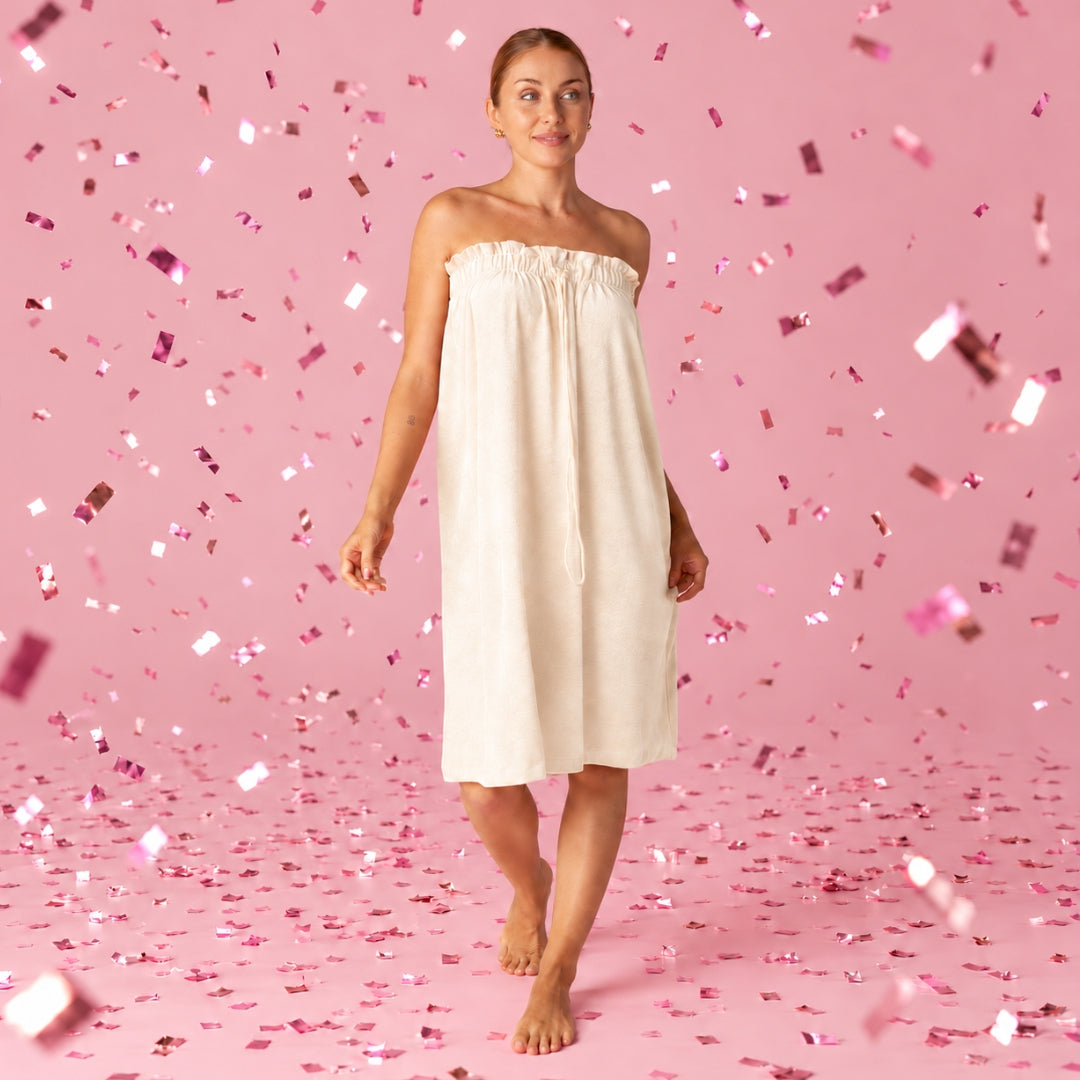

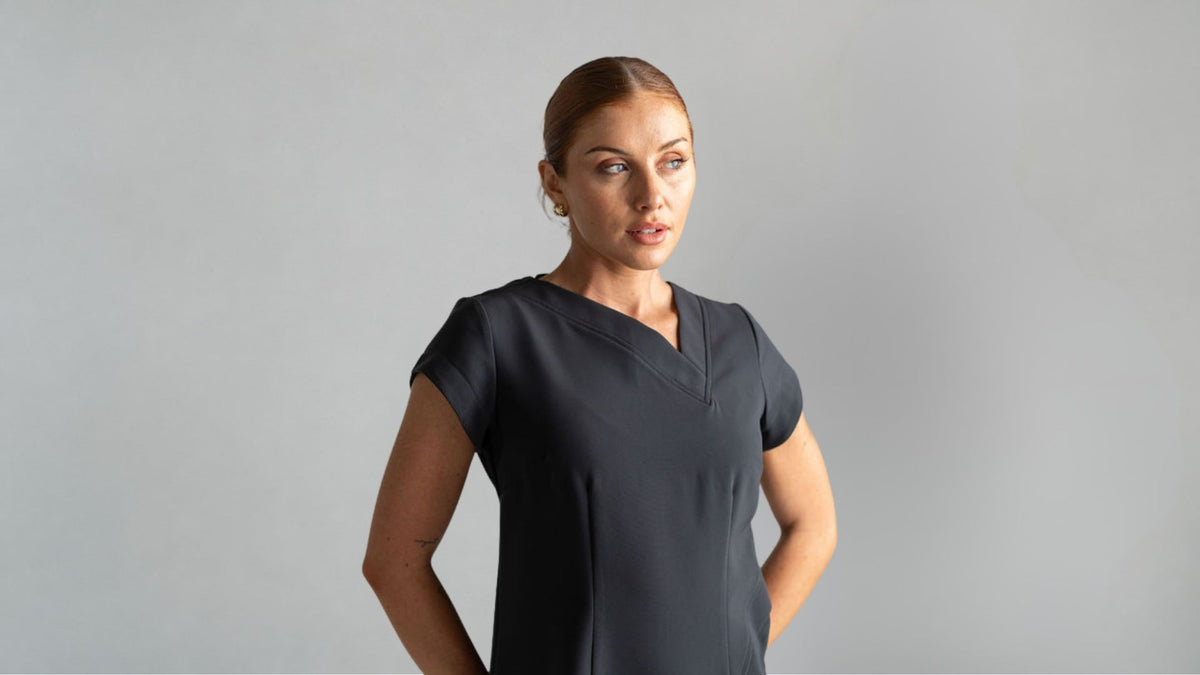
We believe a uniform should be replaced because you want something new, not because it wore out. Most professional uniforms are retired long before they need to be, not from wearing, but from a laundry routine nobody was ever taught. Pilling, fading and stretched-out fabric each have a specific cause, and each is preventable. Our uniforms use fabrics chosen to withstand the washing this work demands, tailored in sizes 4 to 26. Here is how to get every wash out of them.
In this article
- What causes pilling on a uniform?
- Why do uniforms fade?
- Why does a uniform lose its shape?
- What is the right washing routine for salon uniforms?
- Does the routine change by fabric?
- What about hygiene between clients?
- Questions we're often asked
What causes pilling on a uniform?
Almost always one thing, washing uniforms with towels and sheets.
Towelling sheds lint constantly. Those loose fibres work into the weave of everything else in the load, and where the fabric rubs, under the arms, at the hip where you lean on a bed, across the back, they ball into pills.
It is the single most common reason a good uniform looks tired within a few months, and it has nothing to do with the quality of the garment. A team that washes uniforms in with the salon's linen will pill any uniform on the market.
The fix is simply to separate the loads. Uniforms with uniforms. Towels and bed linen on their own. It costs nothing and it is the highest-value change most salons can make.
Turning garments inside out helps too, because it moves the friction to the inside where pilling does not show.
Why do uniforms fade?
Three causes, and heat is involved in two of them.
Hot water. Heat opens the fibre and lets dye migrate out. Cold water cleans uniform soil perfectly well in a domestic machine, and hot washing is a habit rather than a requirement.
Hot drying and direct sun. Both fade fabric quickly. Line drying is excellent, and line drying in full Australian sun is not. Shade, or a dryer on low.
Optical brighteners. Many standard detergents contain them, and they are specifically designed to alter how fabric reflects light. On black and on colour they do exactly what you would not want. Read the label on whatever you are using.
For black uniforms in a colour room there is a fourth cause, bleach and lightener stripping dye directly, which is why our black range is made bleach resistant.
Why does a uniform lose its shape?
Two things, and both are avoidable.
Fabric softener. It works by coating fibres, which is why fabric feels soft afterwards. On a performance fabric that coating blocks breathability and degrades stretch recovery, so the garment stops springing back and starts sitting where you last left it. Softener is the worst thing you can put on a uniform, and it is in almost every laundry cupboard.
Enzyme detergents. Biological powders with enzymes break down protein and can attack elastane over repeated washes. They also contribute to shrinkage. A plain mild detergent does everything a uniform load needs.
There is a third, smaller cause, which is hanging a heavy wet garment on a thin hanger. The weight pulls the shoulders out of shape while it dries. Lay knits flat, hang wovens on something with a bit of width to it.
What is the right washing routine for salon uniforms?
Six habits. None of them takes extra time once they are habits.
Wash uniforms separately from towels and bed linen. The single most important one.
Wash cold, on a normal cycle. Delicate settings are not needed, because heat is the enemy, not agitation.
Turn garments inside out. Moves abrasion to where it does not show.
No fabric softener, no enzyme powder, no optical brighteners. A mild detergent, nothing else.
Dry low, or hang in shade. Take garments out slightly damp rather than fully dried.
Hang immediately. Most of what looks like a creased uniform is a garment left sitting in a warm machine. Thirty seconds here saves the iron entirely.
One more, for teams. Rotate evenly. Everybody has a favourite piece and wears it disproportionately. Rotating across three sets means they wear at the same rate and the team keeps matching, which is what a uniform range is for.
Does the routine change by fabric?
The principles hold across everything. Three fabrics want slightly different handling.
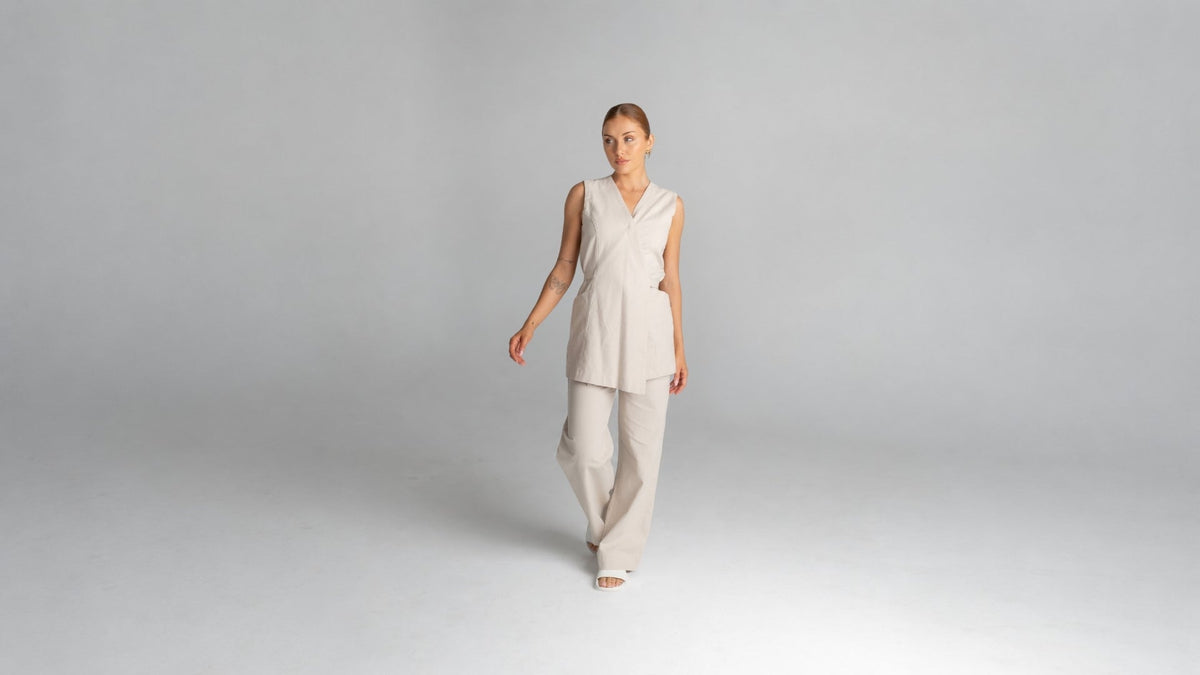
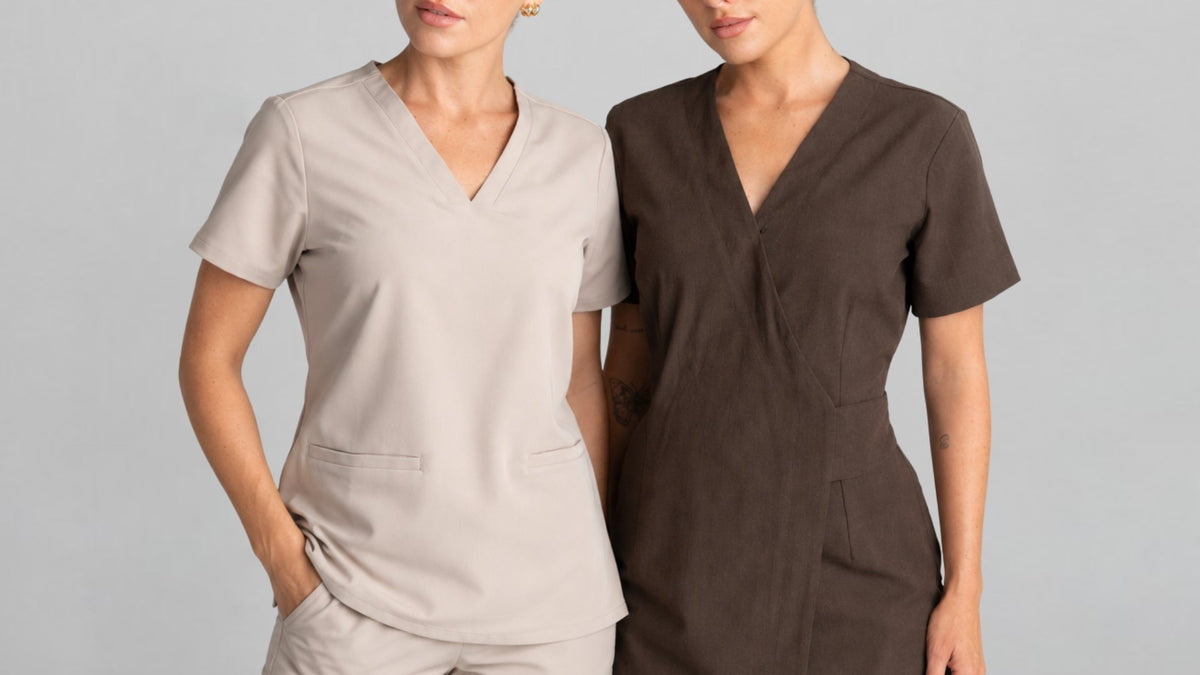
Organic linen-cotton. Robust, and stronger wet than dry. Wash cool on a normal cycle, and skip softener especially, because linen softens beautifully on its own and softener blocks the breathability you bought it for. Line drying suits it. Our linen range is stonewashed before it is made up, so creasing reads as texture rather than as neglect.
Performance knits. Cold wash, low dry, and be strict about softener, because this is where the coating does the most damage to stretch recovery. This covers our Spa Uniform range and our scrubs.
Microfibre bedding. Same rules, and the payoff is speed. Our sheets dry in about seven minutes, which is what lets a busy clinic turn linen around between clients. Softener destroys exactly the wicking that makes that possible.
What about hygiene between clients?
Fabric care and hygiene overlap, but they are not the same question.
Put uniforms through a wash cycle at the end of every working day. Not at the end of the week.
Wear an apron for the messy treatments. Body work, clay, colour and wax are all far kinder to a uniform with a linen apron in between, and an apron is cheaper to replace.
Keep fresh linen for every client. Sheets and covers change between appointments, which is why two or three sets per bed is the working minimum.
Spot clean during the day rather than letting product sit. Cold water on a splash, always, because warm water opens the fibre and helps a chemical do its work.
Increased washing is hard on fabric, which is the argument for buying a uniform that can take it rather than replacing a cheaper one twice a year.
Questions we're often asked
How do you stop uniforms from pilling?
Wash uniforms separately from towels and bed linen. Towelling sheds lint that works into the weave and balls up where fabric rubs, and this is the most common cause of pilling. Turning garments inside out also helps by moving friction to the inside.
Why do salon uniforms fade so quickly?
Hot water, hot drying, direct sunlight and detergents containing optical brighteners all strip or alter colour. In colour rooms, bleach and lightener strip dye from the fibre directly. Washing cold, drying low or in shade, and using a plain mild detergent prevents most fading.
Should you use fabric softener on work uniforms?
No. Softener works by coating the fibre, which blocks breathability and degrades stretch recovery so the garment stops holding its shape. On microfibre it also destroys the wicking that makes linen dry quickly. A mild detergent alone is better for every fabric in a salon.
What temperature should salon uniforms be washed at?
Cold, on a normal cycle. Heat is what fades colour, degrades elastane and causes shrinkage. Cold water handles ordinary uniform soil, and a mild detergent does the rest.
How often should salon uniforms be washed?
After every working day, not at the end of the week. Wearing an apron during messy treatments reduces how much a uniform picks up, and rotating across three sets means no single garment carries all the wear.
How do you get oil or product out of a uniform?
Treat the splash immediately with cold water, never warm, which opens the fibre and helps the product set or react. Blot rather than rub, and wash the garment at the end of the day rather than letting it sit.
Browse our Spa Uniforms, Linen Uniforms and Spa Bedding, built to withstand the washing this work demands.


Why Presentation Is Everything in a Salon
What to Replace in Your Salon Before the New Year