


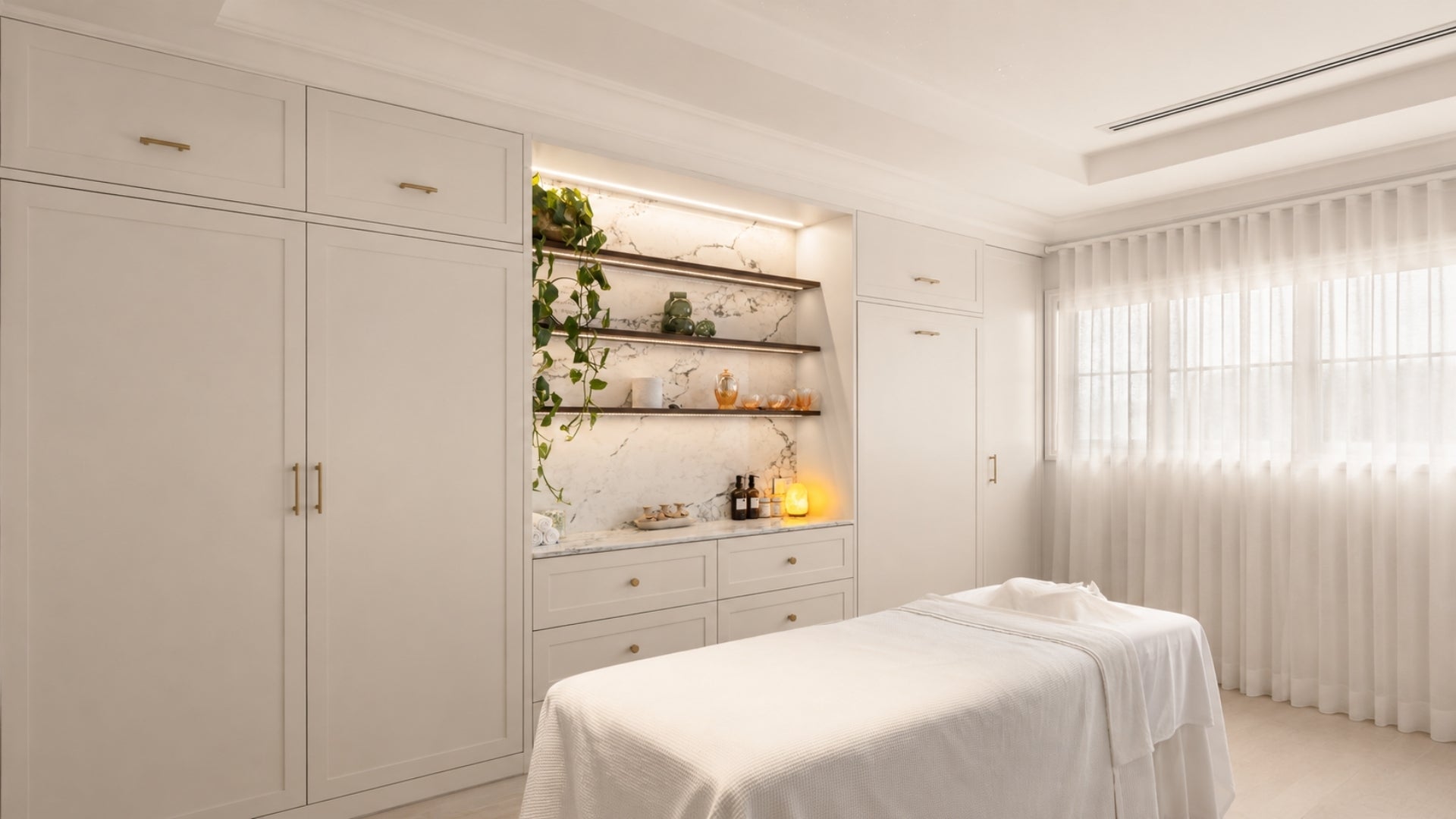
We believe a treatment room should be refreshed on a schedule, not when something finally looks bad enough to notice. The difficulty is that a room ages slowly. You see it every day, so the faded valance and the tired robe become invisible to you long before they become invisible to a client. A refresh does not have to mean a renovation. Most of what dates a room is linen, uniforms and light, and all three can be changed in an afternoon.
In this article
- Why does a treatment room look dated before you notice?
- What should you replace first?
- When is a uniform range past refreshing?
- What lifts a room without a renovation?
- What is not worth changing?
- When is the best time to do this?
- Questions we're often asked
Why does a treatment room look dated before you notice?
Because deterioration is gradual and you are in the room every day.
Nothing in a treatment room fails suddenly. A white sheet greys over eighteen months. A black uniform drifts to charcoal across a season. A robe flattens with each wash. Not one of those is a moment you would notice, and by the time a change is obvious to you, it has been obvious to clients for a while.
The way around it is to stop trusting your eye and use a fixed check instead. Once a year, walk into each treatment room as though you were a client seeing it for the first time. Better still, photograph it. A photograph is unsentimental in a way you cannot be, because stains, mismatched tones and tired fabric all show up in an image that you look straight past in the room.
What should you replace first?
The bed, every time.
It is the largest object in the room, the thing a client looks at on entering, and the thing they spend the whole appointment lying on. It is also where wear shows fastest, because it is laundered hardest.
Sheets and covers. Plan on replacing these annually in a busy room. If a sheet still smells faintly of oil after washing, or has shadowing you can see in daylight, it is finished, and a client will notice both before you do.
The valance. If your bed base is visible, with brackets, wiring or boxes of stock underneath, this is the highest-impact single change available to you. A valance takes the least considered part of the room and removes it entirely.
Face cradle covers. The one piece a client puts their face directly into, and usually the most neglected.
Refreshing linen also lets you change the room seasonally without changing anything structural. A different colour across the bed reads as a new room for the cost of a set of sheets.
When is a uniform range past refreshing?
There are three honest signals.
The team no longer matches. This is the most common and the most damaging. It happens when garments are replaced one at a time, or when everyone wears a favourite piece disproportionately, so the range ends up in several shades. A team in three tones of black looks unplanned regardless of how good each garment is.
Staff have started adapting it. Cardigans over the top, sleeves pushed up, a different pair of pants because the originals no longer fit. Every adaptation is feedback that something is not working.
It no longer matches the room. Salons redecorate and forget the uniforms, which is how a warm, natural room ends up with clinical white tunics in it.
When you do refresh, replace the whole range at once rather than piece by piece. That is the only way a team stays visually consistent, and it is the reason to buy three sets per person up front rather than one.
What lifts a room without a renovation?
Lighting. Bulbs dim gradually and colour-shift as they age. Replacing them is the cheapest change on this list and one of the most noticeable. Warm, dimmable light for treatment, brighter and more accurate light where you need to actually see skin.
Paint. A single coat in the same colour brightens a room more than people expect. Walls collect marks at trolley height and around door frames.
A deep clean. Not your usual clean, but skirtings, vents, the tops of cupboards, the underside of the bed. Rooms accumulate a film you stop seeing.
Plants. Real ones, and only the ones you will actually maintain. A struggling plant is worse than no plant.
Scent and sound. Both are noticed immediately and cost almost nothing to change.
Towels. Tired towelling is on display through every treatment and is usually the last thing anyone thinks about.
What is not worth changing?
Plenty, and knowing this saves money.
Anything structural that still works. Beds, trolleys and cabinetry rarely need replacing on aesthetic grounds. Reupholstering a bed costs a fraction of replacing it.
Your colour scheme, if it suits you. Chasing a trend is how rooms end up dated faster. A palette chosen because it suits your brand ages far better than one chosen because it was current.
Anything you are changing only because it is a new year. The date is a prompt to look, not a reason to spend.
The point of an annual review is to find the two or three things genuinely letting the room down, usually linen, usually lighting, sometimes uniforms, and fix those properly rather than spreading a budget thinly across everything.
When is the best time to do this?
Australian salons have two natural windows.
January, when bookings are quieter after the Christmas rush and there is time to actually do the work. A refresh here also carries you through the year with the room looking its best for the busiest period ahead.
June, before the end of the financial year, when replacing worn stock may make sense alongside other end-of-year decisions. Speak to your accountant about how uniform and equipment purchases are best treated for your business, because that is their advice to give, not mine.
Whichever you choose, put it in the calendar as a recurring task. The whole problem is that nobody notices a room ageing, so the solution has to be a date rather than a judgement.
Questions we're often asked
How often should you refresh a treatment room?
Review each room annually and replace what has genuinely worn rather than everything at once. Bed linen typically needs replacing yearly in a busy room, lighting every year or two, and uniform ranges every two to three years or whenever the team stops matching.
How do you know when salon bed linen needs replacing?
Visible staining or shadowing in daylight, and a faint oil smell that survives washing. Both are noticed by clients before owners, because owners see the linen daily and stop registering gradual change. Photographing the made bed is a more reliable check than looking at it.
What is the cheapest way to make a treatment room look better?
Replace the lighting and the bed linen. Bulbs dim and colour-shift gradually, and the bed is the largest object a client sees and lies on. A bed valance is the single highest-impact change in any room where the bed base is currently visible.
When should a salon replace its uniforms?
When the team no longer matches, when staff have started adapting the uniform with cardigans or substitute pants, or when the range no longer suits a redecorated room. Replace the whole range at once rather than piece by piece, which is what causes mismatched tones in the first place.
When is the best time of year to refresh a salon?
January, when bookings ease after the Christmas period and there is time to do the work properly, or June before the end of the Australian financial year. Put it in the calendar as a recurring task rather than waiting to notice a problem.
Browse Spa Bedding, Spa Uniforms and Gowns and Headbands, in sizes 4 to 26.




What Actually Ruins a Uniform, and How to Prevent It
Why the Robe You Give Clients Is Part of the Treatment