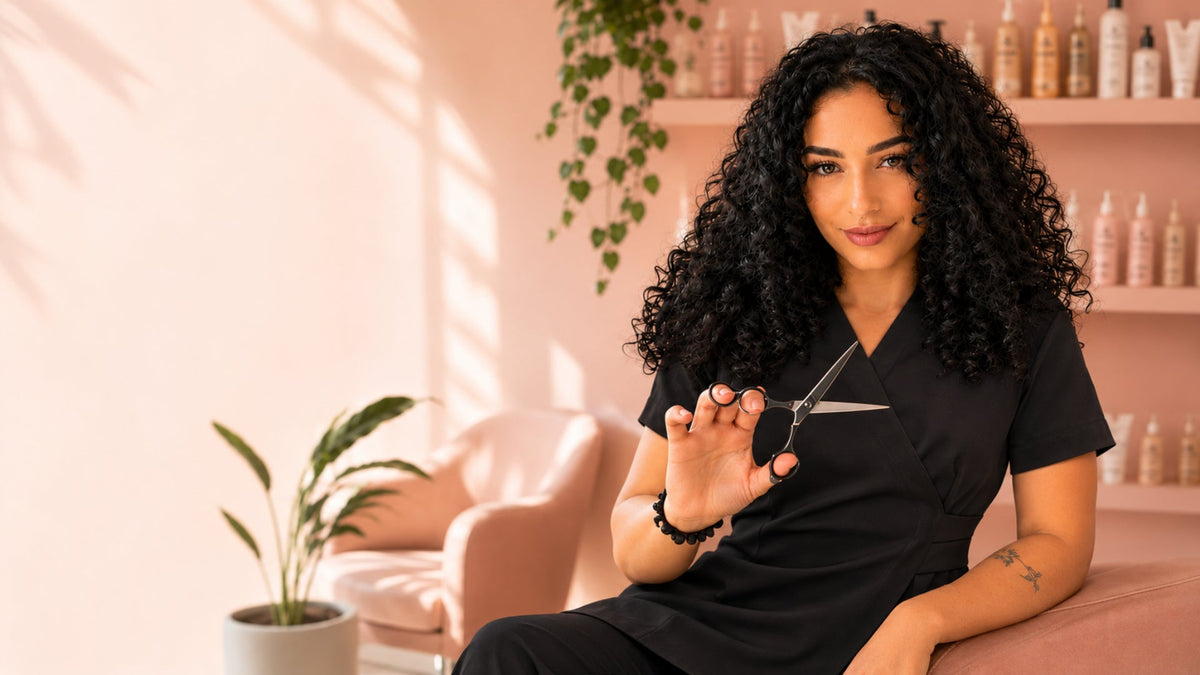
We believe a uniform should do something a t-shirt cannot. That is easy to assert and harder to prove, so it is worth hearing from someone who made the switch and can tell you exactly what changed. Sara runs Aria Curly Salon, a curly hair specialist studio on Industrial Avenue in Molendinar, the same street we are on. Clients travel from Brisbane, Northern NSW and interstate to see her. Until recently she wore plain black t-shirts, the same ones you would see in any salon.
In this article
- Who is Aria Curly Salon?
- What was wrong with black t-shirts?
- Why the Spa Uniform 12?
- How does it handle dry curl cutting?
- She tested the bleach claim herself
- What changed in the salon
- The one thing she changed about it
- Questions we're often asked
Who is Aria Curly Salon?
A specialist curly hair studio on the Gold Coast, offering curl-by-curl cutting, colour, head spa treatments and curl education.
Curly hair is its own discipline. Most hairdressing training is built around straight hair and adapted, which is why so many people with curls arrive at a specialist salon after years of disappointing appointments. Sara's clients frequently come in having had a bad experience elsewhere, and a significant part of what she is selling is confidence, that this time, someone knows what they are doing.
That matters for a uniform more than it sounds. When a client arrives anxious and looking for reassurance, everything in the room is part of the answer, and what the stylist is wearing is the first thing they see.
Aria also runs long appointments. A proper curly cut with education built in can run two to three hours, and head spa treatments add water and product on top of the cutting and colour work.
What was wrong with black t-shirts?
Nothing, and that was the problem.
As Sara puts it, they were plain black t-shirts you would see at any other salon. They did the job. They were black, they were clean, they covered what needed covering.
But a specialist studio charging specialist prices, with clients travelling interstate to visit, was presenting itself the same way as every general salon on the coast. The expertise was in the work and nowhere in the room.
This is the most common version of the uniform problem we see, and it is quiet rather than dramatic. Nothing is broken. Nobody complains. The business just does not look like what it is.
Why the Spa Uniform 12?
The Spa Uniform 12 is our strongest-selling style across the whole business, and it suits salon work for reasons that are not obvious from a photograph.
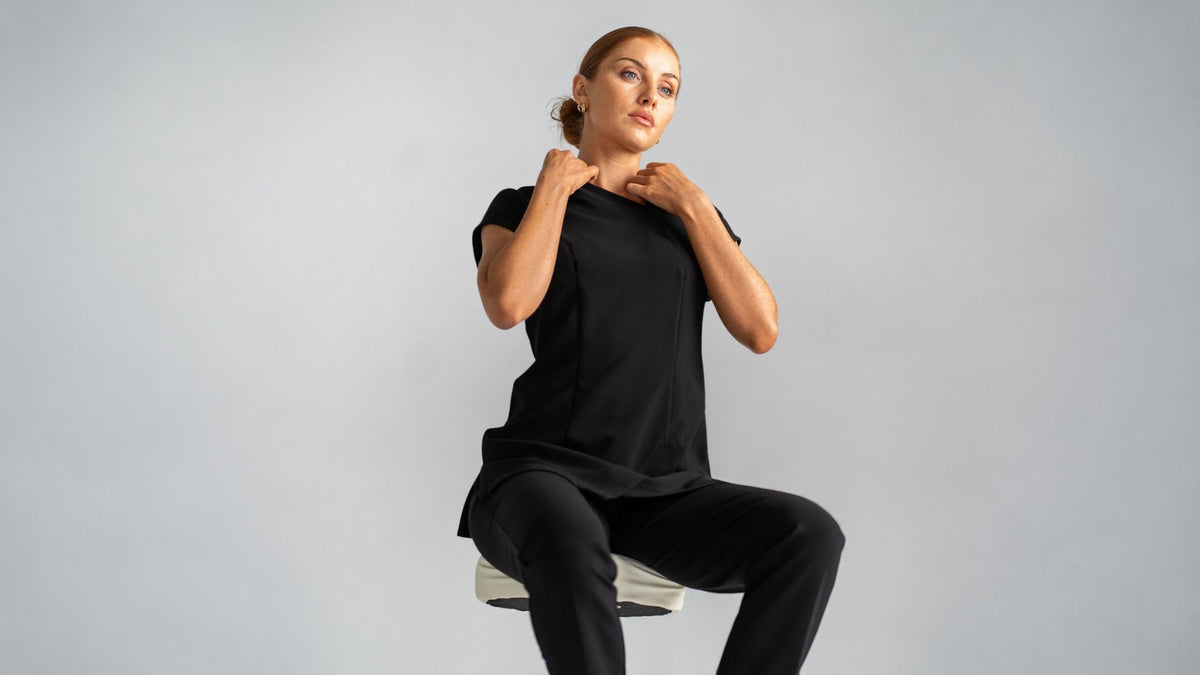
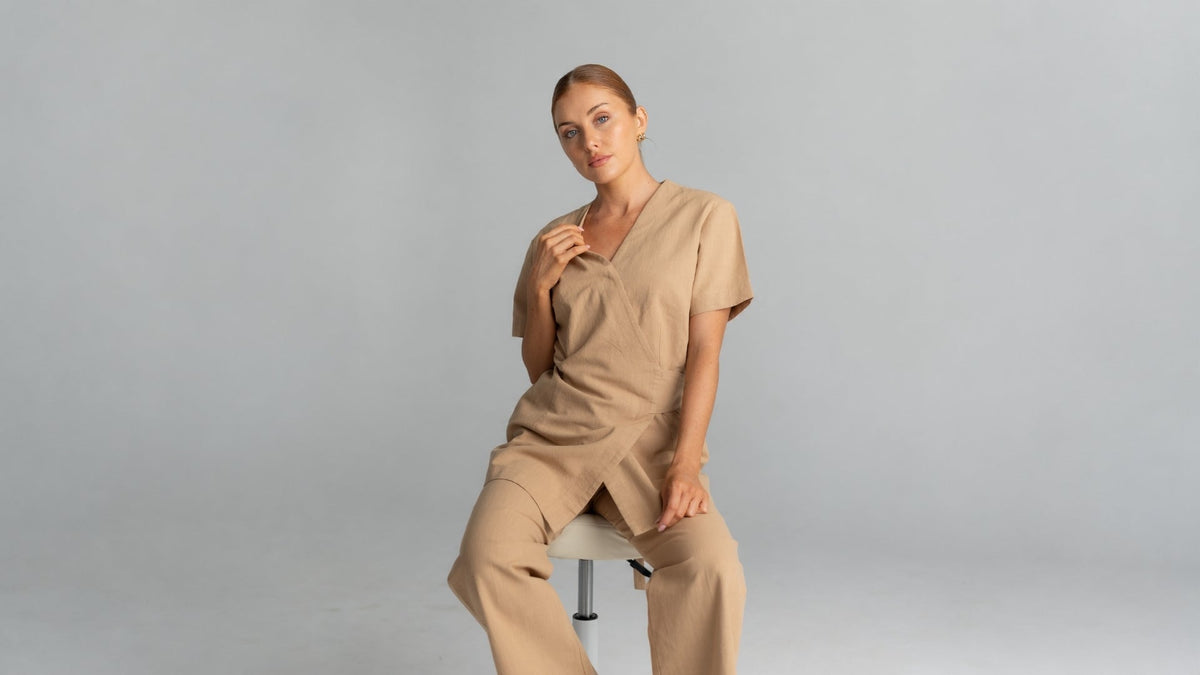
The wrap front with a secure back tie holds its position. It does not shift when you lean in toward a client's head, and it does not gape when you look down at a section. For work done at close range with a client watching in a mirror, that matters.
The other thing Sara raised was fit, and it surprised her. Her words, surprising how well it fit.
That reaction is common enough that it tells you something about the category. Most people's expectation of a uniform is set by generic small, medium and large, so a garment cut as a tailored fit across sizes 4 to 26 reads as unexpectedly well made, when really it is just tailoring, which uniforms stopped doing decades ago because grading a full size run costs more.
On the fabric, she said it was noticeably different and unlike anything she had really seen before. Our Signature fabric is 92% polyester with 8% spandex, with four-way stretch and a smooth face. It is not exotic. It is simply specified better than the fabric most uniforms are made from, and in the hand that is obvious immediately.
How does it handle dry curl cutting?
This was the question I most wanted answered, because dry curl cutting is the hardest test of a salon uniform there is.
Cutting curls dry, curl by curl, produces very fine clippings across the whole appointment rather than in one wash-and-cut burst. Those clippings cling to anything with texture, so brushed fabric, waffle, knit with a visible face, anything soft-handed. In a salon doing dry cuts all day, a uniform that collects hair means brushing yourself down constantly, in front of a client.
Sara's assessment was straightforward. The fabric is great with dry cuts.
That comes down to the weave. A tightly woven fabric with a smooth face lets cut hair slide off or brush away in one pass, rather than working into the surface and staying there. It is why we do not recommend our linen range for hairdressing, beautiful as it is, because natural fibre with texture is exactly what hair grabs onto.
The full explanation of why some fabrics shed and others collect is in why most uniforms fail in a hair salon.
She tested the bleach claim herself
This is my favourite part, and it is the kind of thing I would rather a client did than took our word for.
Sara put bleach on the garment deliberately, to see what would happen. Not a splash she rinsed in a panic, an actual test.
Her result, no problems.
We say bleach resistant rather than bleach proof, and we mean it. No fabric is immune, and leaving neat lightener sitting on any textile long enough will mark it. What resistant means is that the fabric is built to take the daily contact of a working colour room and hold its colour through it, rather than drifting to a tired charcoal within a season.
A colourist testing it on purpose is a better demonstration of that than anything we could write. The mechanism behind it, why standard blacks fade and what actually strips the colour, is covered in why your black uniforms fade.
What changed in the salon
Sara's answer was about her clients, not about herself.
It elevated the salon, and because she has strong relationships with her clients, they noticed and told her. She gets compliments on it constantly.
Two things are worth pulling out of that.
Clients notice more than owners expect. People are reading a room and the people in it whether or not they say anything. In a salon where the relationships are close enough that clients do say something, you find out, and the response is consistently positive.
The compliments are the measurable part. Nobody compliments a black t-shirt. The switch turned something invisible into something clients mention, which is a small ongoing conversation about the business being considered, happening without Sara having to say a word about it.
For a studio where clients travel interstate and arrive hoping they have finally found the right person, looking like the specialist she is does real work.
The one thing she changed about it
I asked whether she would change anything, and the answer made me laugh. Once her order arrived, she took it away and had her own logo embroidered onto it.
Which is exactly the right way round, and it is worth explaining why.
We do not offer embroidery, deliberately. The moment a garment is embroidered it cannot be returned or exchanged, and the most common thing that goes wrong with a uniform order is sizing. A salon owner ordering for a team of six who guesses one size wrong should be able to swap it, and if we have already stitched a logo onto it, she cannot. She is stuck with a garment nobody can wear, and we have taken her money for it.
So the sequence Sara followed is the one we would recommend to anyone. Order it. Try it on. Confirm the fit is right across your whole team. Then take it to an embroiderer.
Local embroidery is inexpensive and quick, and doing it that way means the only garments carrying your logo are the ones you have already confirmed fit. It costs you one extra step and it removes the risk entirely.
Questions we're often asked
What uniform is best for a curly hair salon?
A tightly woven fabric with a smooth face, because dry curl-by-curl cutting produces fine clippings across a whole appointment and textured fabric collects them. A wrap style with a secure tie also holds its position when leaning in toward a client's head. Aria Curly Salon on the Gold Coast wears the Spa Uniform 12.
Does a uniform actually make a difference to how clients see a salon?
Yes, and in salons with close client relationships you hear about it directly. Aria Curly Salon switched from plain black t-shirts and reports regular unprompted compliments from clients, something that does not happen with a generic tee.
Is bleach-resistant fabric actually bleach resistant?
Resistant, not proof, because no fabric is immune and neat lightener left sitting on any textile will eventually mark it. Sara at Aria Curly Salon tested bleach on her Spa Uniform 12 deliberately and reported no problems. Resistant means the fabric holds its colour through the daily contact of a working colour room.
Does Spring Spa Wear embroider logos onto uniforms?
No, and it is a deliberate decision. An embroidered garment cannot be returned or exchanged, and sizing is the most common thing that goes wrong with a uniform order. Order first, confirm the fit across your team, then take the confirmed garments to a local embroiderer, so only garments you know fit ever carry your logo.
Why do uniforms fit better than a standard small, medium and large?
Because a tailored range is graded across the full size run, with shaping through the body and proportions that change with the size. Small, medium and large exists to reduce manufacturing cost, not to fit anyone in particular. Spring Spa Wear cuts every style as a tailored fit in sizes 4 to 26.
You can find Aria Curly Salon at Suite 1, Unit 11/15 Industrial Avenue, Molendinar, or at ariacurlysalon.com.au.
Browse the Spa Uniform 12, our Hair Salon Uniforms and the Bleach Resistant range, tailored sizes 4 to 26.

Why the Cheaper Uniform Usually Costs More