
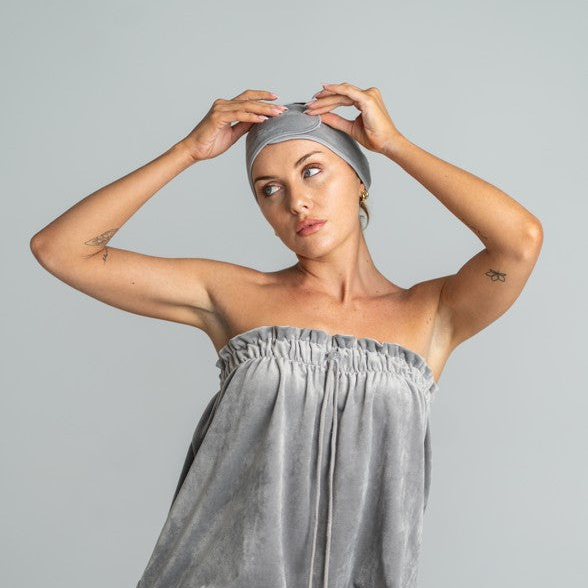
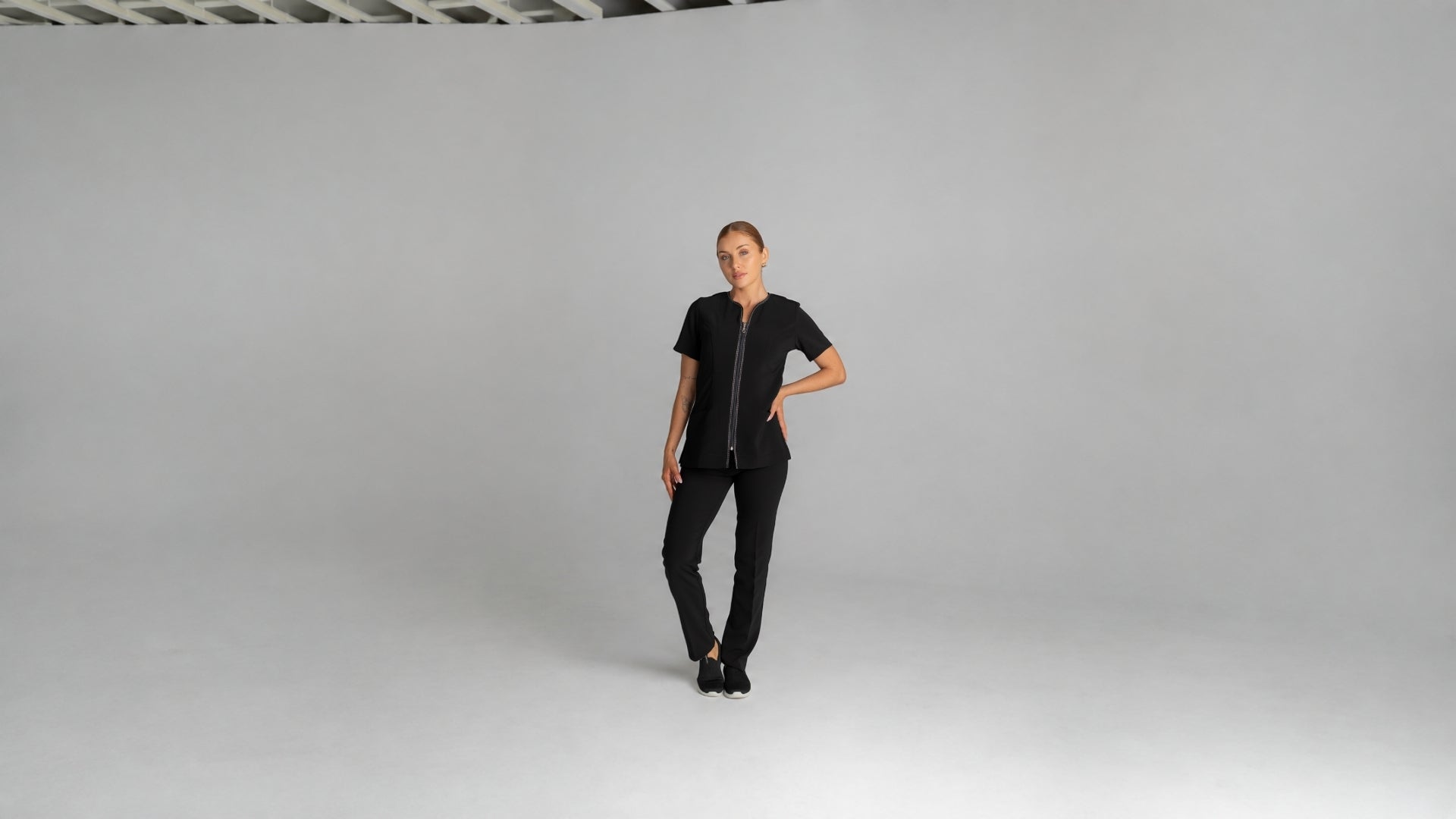
We believe a uniform should survive the room it works in. A hair salon is one of the hardest rooms in the industry, with cut hair that clings to everything, arms held at height for hours, and a colour bench that ends most garments within a season. Most uniforms are designed for a treatment room and then sold to salons as an afterthought. Ours are cut longer, made from a smooth-faced fabric that sheds rather than collects, and offered in a black that is bleach resistant. Tailored, sizes 4 to 26.
In this article
- Why do most uniforms fail on a salon floor?
- How do you stop cut hair clinging to your uniform?
- Why does shoulder room matter so much in hairdressing?
- What about the colour bench?
- Why length and pockets matter
- Which styles suit salon work?
- Dressing a salon team
- Questions we're often asked
Why do most uniforms fail on a salon floor?
Because they were designed for someone standing still.
Most professional uniforms are built around a beauty or clinical brief, a therapist leaning over a bed, moving slowly, in a controlled room. Hairdressing is a different job entirely. You are on your feet for a full shift, working at head height with arms raised, moving constantly between the chair, the bench and the basin, and surrounded by cut hair and chemicals.
Four things break as a result.
The fabric collects hair instead of shedding it, so you spend the day brushing yourself down.
The garment pulls across the back when you raise your arms, which is uncomfortable within an hour and unbearable by four o'clock.
The hem rides up every time you reach for the top of a head.
The black goes grey within a season, because standard black is not built for a colour room.
None of those show in a product photograph. All four show on day one of wearing it.
How do you stop cut hair clinging to your uniform?
Choose a smooth-faced fabric, and check it before you buy.
Cut hair clings mechanically, catching on anything with texture, loops or a raised surface. Brushed cotton, waffle, knit with a visible face, anything soft-handed in a fluffy way, all of it collects. A tightly woven fabric with a smooth face lets hair slide off, or brush off in one pass rather than twenty.
This is the single biggest practical difference between a uniform that works in a salon and one that does not, and it is almost never mentioned on a product page.
The test. If you can, run your hand across the fabric and then look at it in the light. If it grabs at dry skin, it will grab at hair. Failing that, ask what the fabric is, because a tightly woven performance blend sheds and a brushed or textured natural fibre does not.
Our Signature fabric is 92% polyester with 8% spandex, woven with a smooth face for exactly this reason. It is why the same styles turn up in salons far more than our linen range does, because linen is beautiful, and it is the wrong fabric to stand in while someone is cutting.
Colour helps too, but not the way people assume. Black hides dark hair and shows blonde, and a mid grey is the most forgiving across a mixed clientele. Most salons choose black anyway, because it handles product better.
Why does shoulder room matter so much in hairdressing?
Because you work with your arms up, and almost nothing else in this industry does.
Cutting, blow drying, sectioning and foiling all happen at or above shoulder height, held there for long stretches. A garment that fits perfectly standing with your arms down can pull hard across the back the moment you raise them.
Two things solve it.
Where the shoulder seam sits. It should sit on the edge of the shoulder, not out on the arm. If it has dropped, every raise of the arm drags the whole garment with it.
An action back, or a cut with ease through the shoulder blade. Our Spa Uniform 19 has an action back panel specifically for this, adding extra fabric where you need to move without adding bulk anywhere else.
Test it in the mirror before committing a team. Put the garment on, raise both arms as if foiling, and see whether it pulls or rides.
What about the colour bench?
This is the fastest way to destroy a uniform, and it deserves its own decision.
Bleach and lightener do not stain, they strip dye out of the fibre permanently, which is why a splash you rinse straight away can still leave a lighter patch. Toner and tint run at a high pH and open the fibre so colour migrates out in the next wash.
Standard black uniforms are dyed at the surface, so once that layer is stripped or abraded, the paler fibre beneath shows immediately. It is why a colourist's uniform fades at one shoulder and one hip, the places you lean against the trolley.
Our bleach-resistant range is built to take that daily contact and hold its depth across a year rather than a season. We say resistant rather than proof because no fabric is immune, and leaving neat lightener sitting on any textile long enough will mark it.
The full mechanism, and the washing routine that makes the biggest difference, is covered in why your black uniforms fade.
One cheap addition. A linen apron over the top during colour application takes the worst of it and costs a fraction of a tunic to replace.
Why length and pockets matter
Length. A hem that rides up when you reach for the top of a head is a small irritation that repeats several hundred times a day. We cut our tops longer than a standard tunic for this reason. Longer-line styles also sit better over pants when you are moving constantly.
Pockets. A hairdresser carries more on their person than almost anyone in the industry, with combs, clips and a phone for the next booking. Deep front pockets and side-seam pockets hold their contents when you lean, and patch pockets often do not. It sounds minor until you have lost a comb behind a basin.
Both are the kind of detail you only get from someone who has stood in the garment rather than designed it from a spec sheet.
Which styles suit salon work?
The full range is in Hair Salon Uniforms. These are the ones salons come back to.
Spa Uniform 19, the closest thing we make to a purpose-built salon garment. Zip front, two pockets, contrast piping and an action back for arms-up work.
Spa Uniform 17, a sleeveless wrap with two front pockets. Popular in warmer salons and with colourists who want nothing near their forearms.
Spa Uniform 26, front zip, quick in and out between clients, with a clean neckline that stays put when you lean.
Spa Uniform 12, our strongest seller overall. Wrap front with a secure back tie, in Black, Charcoal Grey and Navy.
Bottoms. Long Pants for full coverage on a salon floor, or Capri Pants through summer.
Aprons. The Lulu for colour work, the Mia Half Apron for lighter days.
Dressing a salon team
One silhouette, one colour. A salon floor is highly visible and a mismatched team reads immediately. Vary the colour by role if you want to, but keep the style consistent.
Three sets each. One worn, one washed, one ready. Salon uniforms are laundered every day and rotating evenly means they fade at the same rate, so the team keeps matching.
Order in one go. Dye lots shift between production runs, so adding one garment six months later will not match the others.
Ask about sleeves. Coverage is a personal preference, and someone uncomfortable with bare arms will quietly avoid a sleeveless style.
Measure rather than guess. Our range is cut as a tailored fit in sizes 4 to 26, and grading varies significantly between brands.
For the full process, including what to ask a supplier, see how to choose uniforms your team will actually want to wear.
Questions we're often asked
What do hairdressers wear to work in Australia?
Most Australian hairdressers and colourists wear black, because it conceals product and tint between clients. The practical requirements are a smooth-faced fabric that sheds cut hair rather than collecting it, freedom through the shoulders for working with arms raised, a longer hem that does not ride up, and bleach-resistant colour if you work the colour bench.
How do you stop hair sticking to your uniform?
Choose a tightly woven fabric with a smooth face. Cut hair clings mechanically to texture, loops and raised surfaces, so brushed, waffle or fluffy fabrics collect it while a smooth performance weave lets it slide off or brush away in one pass. Mid grey is the most forgiving colour across both dark and blonde clients.
Are there bleach proof uniforms for hairdressers?
No fabric is genuinely bleach proof, because neat lightener left on any textile long enough will mark it. Bleach-resistant fabric is engineered so colour survives the daily splashes and contact of a working colour room, holding its depth across a year of frequent washing rather than a season.
What should a hairdresser look for in a uniform?
Five things. A smooth face that sheds hair, a shoulder seam that sits on the shoulder rather than out on the arm, ease through the shoulder blade for arms-up work, a longer hem that stays put when reaching, and deep pockets that hold their contents when you lean forward.
Why do black salon uniforms fade so quickly?
Bleach and peroxide strip dye out of the fibre permanently, high-pH lightener and toner let colour migrate out during washing, and hot washing and friction abrade the surface so it reads dull. Surface-dyed blacks show all three quickly because a paler fibre sits beneath the colour.
Should hairdressers wear aprons?
For colour application, yes. An apron takes the bleach and tint contact instead of the garment underneath, and costs a fraction of a tunic to replace. Over a year it will usually save at least one uniform.
Browse Hair Salon Uniforms, Bleach Resistant Uniforms and Linen Aprons, tailored sizes 4 to 26.


Why One Uniform Has to Handle Every Treatment You Offer
Why Nail Techs Need the Right Apron More Than a New Tunic