

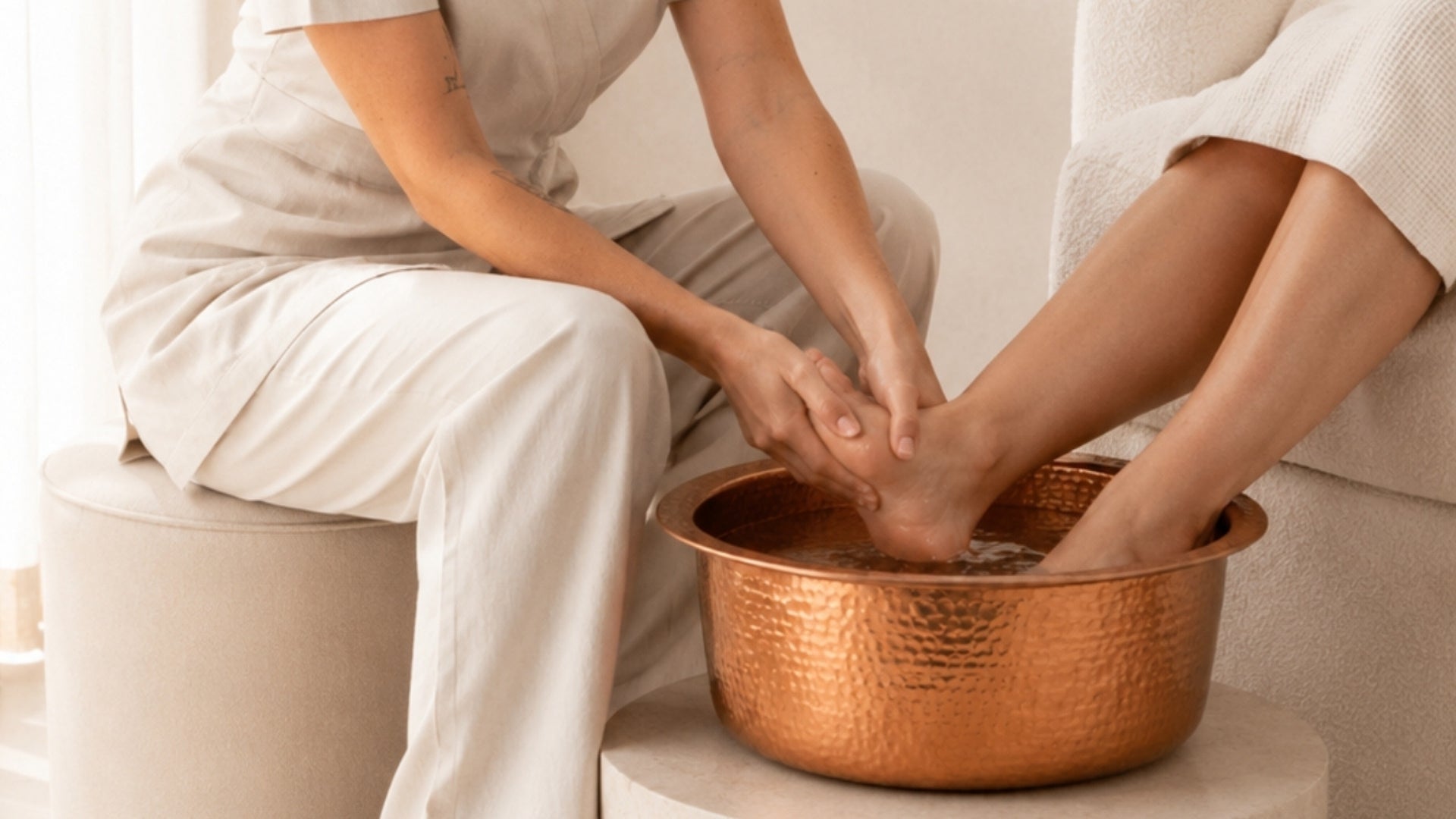
We believe the pedicure deserves better than a plastic tub. It is one of the few treatments a client watches from beginning to end, which makes every object in the room part of the service. Copper has been used for foot soaking for centuries because it holds heat, resists microbes and ages into something worth looking at. So we source it, and we remain the only Australian supplier of copper pedicure bowls, alongside the mats, liners and finishing pieces that make a pedicure station feel deliberate.
In this article
- Why is copper used for pedicure bowls?
- Does a copper bowl really keep water warm longer?
- Which pedicure bowl should you choose?
- What else does a pedicure station need?
- How do you clean and care for a copper pedicure bowl?
- Should you polish copper or let it patina?
- Questions we're often asked
Why is copper used for pedicure bowls?
Copper has been used for water vessels for thousands of years, long before anyone could explain why it worked. Three properties matter in a pedicure room.
It conducts heat exceptionally well. Copper is one of the best thermal conductors of any common metal, which means a bowl warms evenly rather than developing hot and cold patches. It also means the bowl itself becomes part of the treatment, pleasantly warm to the touch rather than a cold object a client puts their feet into.
Copper surfaces are naturally hostile to microbes. This is well documented and is why copper and brass are still specified for high-touch surfaces in hospitals. It does not replace cleaning between clients, and nothing does. But it is a useful property in a vessel that holds warm water and feet all day.
It looks like something. A copper bowl reads as considered in a way moulded plastic never will. In a treatment a client watches from start to finish, that matters more than in almost any other service you sell.
Does a copper bowl really keep water warm longer?
Yes, though the reason is often explained backwards.
Copper conducts heat quickly, so the bowl reaches the water temperature almost immediately and then holds it. A ceramic or plastic vessel takes heat out of the water to warm itself and keeps drawing it, which is why the first few minutes of a soak in a cold plastic tub feel disappointing.
The practical effect is that a client can soak comfortably for longer without a top-up of hot water, and the temperature stays even rather than dropping away while you work. In a treatment where the soak is the relaxing part, that is the difference between a client settling in and a client wondering when it will warm up.
Which pedicure bowl should you choose?
We make two, and they suit different rooms.
The Copper Pedicure Bowl is the traditional choice, hammered copper that develops a patina with use and sits well in a warm, natural or heritage-styled room.
The Retreat Pedicure Bowl is the lighter, more contemporary option, and it is the one we sell most of. It suits a modern or minimal room where a hammered copper finish would sit oddly.
Both are light enough to carry full, which matters more than people expect. A bowl you dread emptying is a bowl that gets used less.
You can see both in the Pedicure Bowls collection.
What else does a pedicure station need?
A bowl on its own is not a station. What surrounds it does most of the work of making the treatment feel finished.
A mat. It keeps the floor dry, gives a client somewhere to put their feet before and after, and stops the area looking like a wet patch of carpet by the third appointment.
Somewhere for the therapist to sit properly. Pedicure is worked low. A stool at the wrong height ruins backs, and it happens slowly enough that people do not connect the two.
Towels you are happy for a client to see. A pedicure is watched, so tired towelling is on display for the whole appointment.
An apron. A linen apron takes the water and product that a low-worked treatment inevitably sends towards your lap.
A uniform you can work low in. Pedicure is done bent forward. A tunic that gapes at the neckline is uncomfortably obvious in this treatment specifically, which is why the Nail Salon Uniforms range is cut for it.
How do you clean and care for a copper pedicure bowl?
Empty and clean it after every client. Feet carry more than most people care to think about, and a warm bowl is a warm bowl.
A disinfectant of your choice will handle routine cleaning. For a deeper clean, a mild bleach solution of roughly one part bleach to three parts water is effective. Rinse thoroughly afterwards.
Dry it properly, every time. This is the step people skip and it is the one that matters most. Water left sitting in copper causes marking and accelerates patina unevenly, which is what produces a blotchy bowl rather than an attractive one. A soft cloth, and a minute of attention.
Wash mats monthly in warm soapy water, and wipe down as needed between times.
Should you polish copper or let it patina?
Either, but decide and be consistent.
Copper darkens with exposure to air and water. Left alone, it deepens into a rich, warm tone that many spas prefer, because it suits a natural or heritage room and it requires nothing of you beyond drying the bowl.
If you want it bright, a copper polish will return it, but it becomes an ongoing commitment rather than a one-off. Polish some weeks and not others and you get an uneven finish that looks worse than either extreme.
My advice is to choose based on the room. A minimal, contemporary space usually wants the polished look or the Retreat bowl instead. A warm, natural room is better served by letting the copper do what copper does.
Questions we're often asked
Are copper pedicure bowls better than plastic or ceramic?
Copper conducts heat far better, so the bowl reaches water temperature quickly and holds it rather than drawing heat away. Copper surfaces are also naturally hostile to microbes, though this does not replace cleaning between clients. The main trade-off is that copper needs drying properly after every use.
Where can you buy copper pedicure bowls in Australia?
Spring Spa Wear is the only Australian supplier of copper pedicure bowls. Both the traditional hammered Copper bowl and the contemporary Retreat bowl are available through the Pedicure Bowls collection.
How do you clean a copper pedicure bowl?
Empty and disinfect after every client. For a deeper clean use a mild bleach solution of about one part bleach to three parts water, then rinse thoroughly. Always dry the bowl completely with a soft cloth, because water left sitting in copper causes uneven marking.
Does copper go green or tarnish?
Copper darkens and develops a patina with exposure to air and water. Left alone it deepens into a warm tone that suits natural and heritage rooms. It can be returned to a bright finish with copper polish, but that becomes an ongoing routine rather than a one-off.
Do copper bowls keep water warm longer?
Yes. Because copper conducts heat so efficiently, the bowl matches the water temperature almost immediately instead of continuing to draw heat from it. A client can soak comfortably for longer without a top-up, and the temperature stays even.
Browse the Pedicure Bowls collection, our Nail Salon Uniforms and Linen Aprons, in sizes 4 to 26.




Why the Robe You Give Clients Is Part of the Treatment
Why Most Spa Bedding Is Really Just Massage Table Linen