

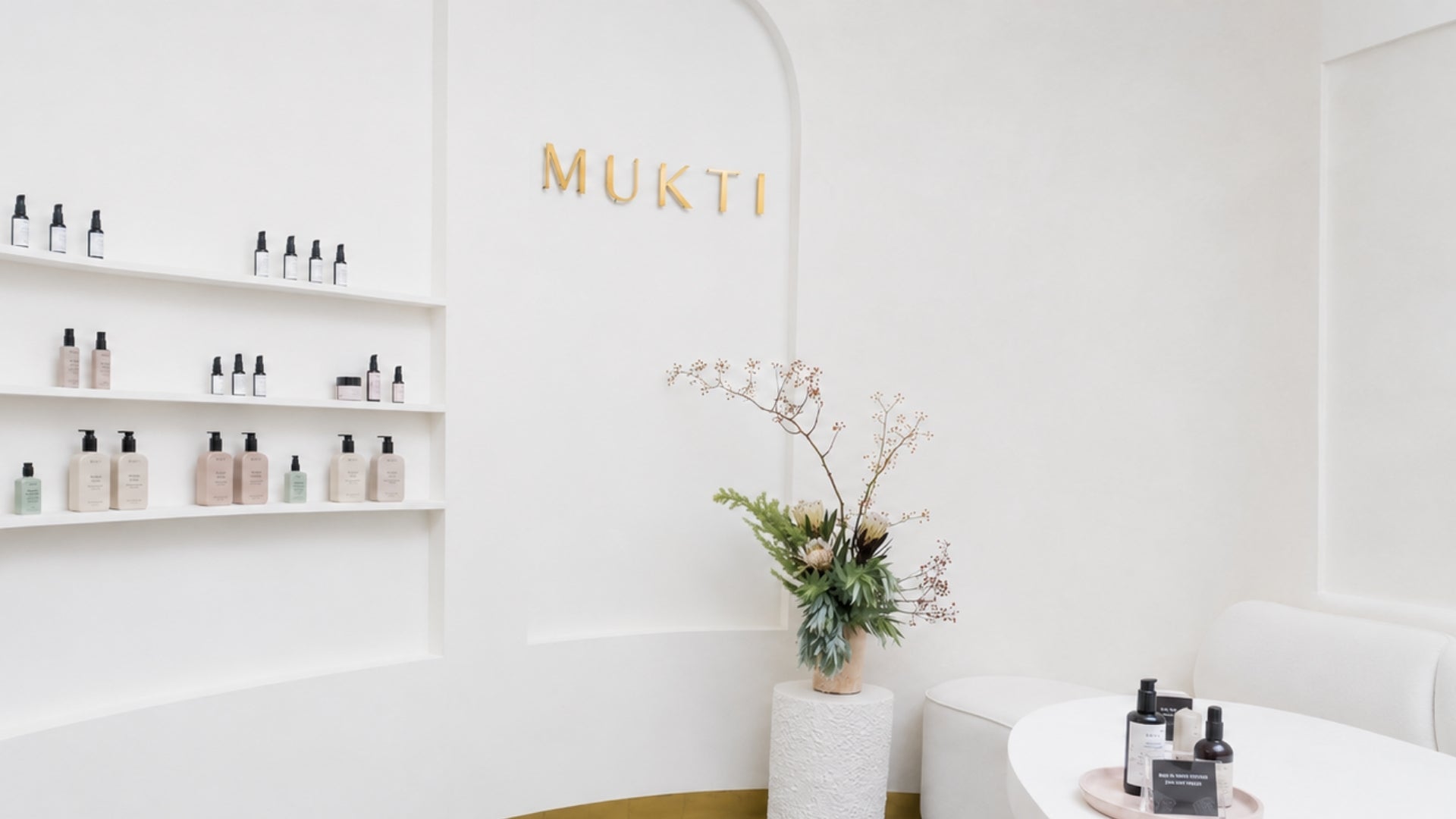
We believe a uniform should belong to the room it is worn in. That is easy to say and harder to do, because most uniform ranges are designed to be inoffensive everywhere rather than right somewhere. When we photographed our linen range at Mukti Beauty Rooms in Mullumbimby, the fit was immediate. An organic skincare brand, a building full of natural light and timber, and a uniform made from organic linen-cotton rather than the polyester the rest of the industry uses. Everything in that room was the real version of itself.
In this article
- Who are Mukti Organics?
- Why did organic linen-cotton suit them?
- What did the team choose, and why?
- What can other salons take from this?
- Questions we're often asked
Who are Mukti Organics?
Mukti Organics is an Australian certified organic skincare brand, founded by Mukti, who has worked in beauty and personal care for more than two decades. The range is formulated using native Australian botanical extracts, and she is also the author of Truth in Beauty, a book about what is actually in skincare and personal care products.
The brand is vegan and cruelty free, uses certified organic ingredients grown and harvested ethically, manufactures under GMP ISO 22716, keeps packaging recyclable, and donates a portion of sales to conservation and environmental foundations.
Their beauty rooms in Mullumbimby, in the Northern Rivers of New South Wales, are where the brand is experienced rather than just bought, a calm, light-filled space that reads exactly as the products do.
We shot there not long after the 2022 Northern Rivers floods. The town had been devastated, and Mukti's space had escaped by a matter of centimetres, with water reaching the front door. That the rooms were open at all that year was its own achievement.
Why did organic linen-cotton suit them?
Because a brand built on natural, certified organic formulations cannot credibly dress its team in polyester.
This is the part most salons underestimate. A client who has chosen you specifically because you are natural, organic or low-tox is paying attention to detail, and that is the whole reason they sought you out. They notice packaging. They read ingredient lists. They will absolutely notice if the therapist applying a certified organic serum is wearing a synthetic uniform made to look like linen.
It is not that anyone objects out loud. It is that the room stops being consistent, and consistency is what a considered brand is actually selling.
Our linen range is organic linen-cotton, real flax fibre, stonewashed so it softens and drapes rather than creasing sharply. It remains the only range of its kind available in Australia, because every other professional uniform range here uses faux linen, which is polyester woven to look the part.
For Mukti, that was not a nice-to-have. It was the only option that did not contradict the business.
What did the team choose, and why?
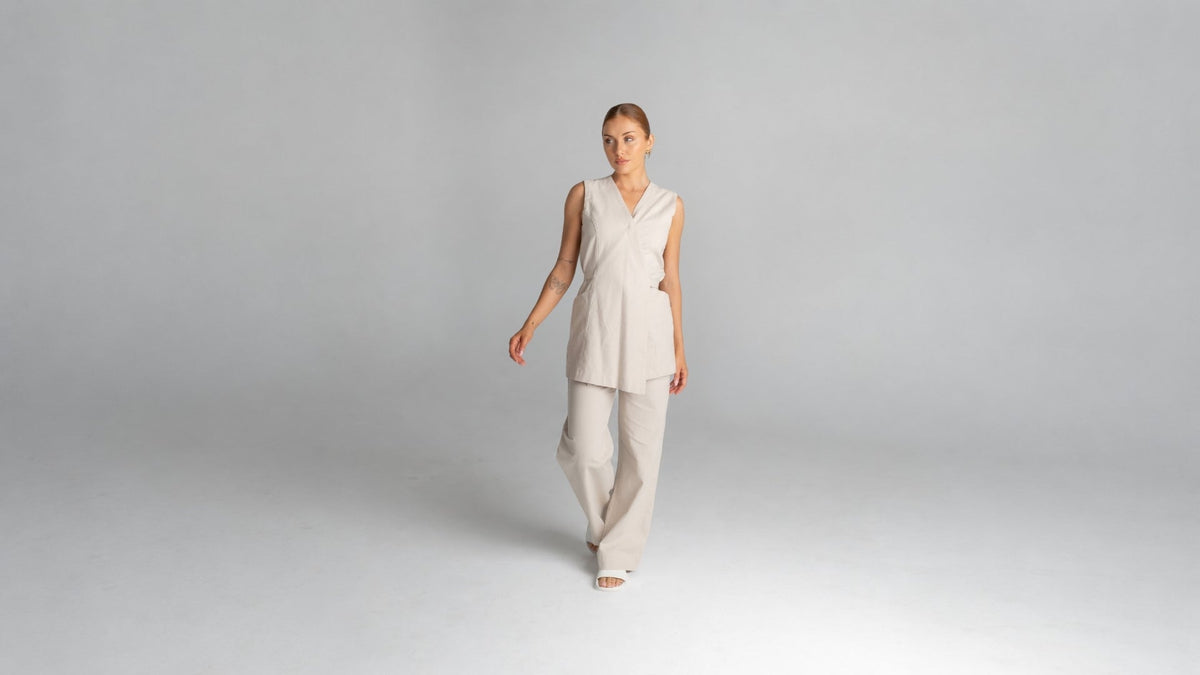
After the shoot the team settled on the sleeveless Fleur Linen Tunic with matching Willow Linen Pants, in Natural.
Three reasons that combination works for a treatment-focused room.
Sleeveless suits hands-on work. Facials and body treatments are worked with arms raised and extended. A sleeveless tunic removes the fabric that would otherwise drag across a client or bunch at the elbow.
The set ages as one. Tunic and pants from the same fabric family soften at the same rate and hold the same tone. Mixing fabrics is how a uniform stops looking like a uniform after a year.
Natural belongs in that room. Against timber, plants and daylight, a neutral linen tone disappears into the space in the best way. A stark white or a hard black would have fought it.
Both styles are cut as a tailored fit in sizes 4 to 26, which matters in a small team where one generic size range would leave somebody in a compromise.
What can other salons take from this?
Start from what your business claims to be. If you sell organic, natural or low-tox, your materials should match your message. If you are clinical and precise, your uniform should be too. The mistake is choosing a uniform on appearance alone and hoping it happens to fit.
Let the room choose the colour. Walk into your own space and look at what is already there, the timber, the paint, the light. The uniform should sit inside that palette, not compete with it.
Buy the set, not the piece. A tunic from one range and pants from another will diverge in tone within months.
Check that your team can actually work in it. The best-looking uniform in the world fails if it drags during a facial.
You can see Mukti's range at muktiorganics.com.
Questions we're often asked
What uniforms do organic and natural salons wear?
Salons built on natural or organic positioning increasingly choose natural-fibre uniforms rather than polyester, because a synthetic uniform contradicts the brand message. Organic linen-cotton is the usual choice, because it breathes, softens with washing, and sits visually alongside timber, plants and natural light.
Is linen suitable for a working treatment room?
Yes, when it is blended and stonewashed. Pure linen creases too sharply for professional wear. A stonewashed linen-cotton blend keeps the breathability and drape of real linen while creasing into a soft texture rather than hard folds, and it becomes softer with every wash.
How do you choose a uniform colour for a salon?
Start with the room rather than the trend. Look at the existing timber, paint and light, and choose a tone that sits inside that palette. Natural and neutral tones suit warm, organic rooms, while sharper whites and blacks suit clinical spaces.
Which Spring Spa Wear styles are made from organic linen-cotton?
The full Linen Uniforms collection, including the Fleur, Eden and Avery tunics, Willow Linen Pants, Linen Jogger Pants, the Ava Linen Dress, the Lulu and Mia aprons and the Kia Mens Linen Shirt. All are cut as a tailored fit in sizes 4 to 26.
See the full Linen Uniforms collection, or read more about why we use real linen when every other brand uses faux.


Why Most Spa Bedding Is Really Just Massage Table Linen
Where to Try Our Uniforms On in Queensland