

We believe a uniform should get better with wearing, not worse. That belief is why we chose organic linen-cotton when the entire uniform industry moved to faux linen, a polyester woven to look like the real thing. Real linen breathes, softens and ages into something a therapist wants to put on. So we source it, stonewash it, and cut it as a tailored fit in sizes 4 to 26. Spring Spa Wear is the only Australian supplier of organic linen-cotton professional uniforms. Every other range on the market is faux.
In this article
- What is the difference between real linen and faux linen?
- Why does almost every uniform brand use faux linen?
- How does organic linen-cotton wear in a treatment room?
- Why do we stonewash our linen?
- Which of our styles are made from organic linen-cotton?
- How do you care for a linen uniform?
- Questions we're often asked
What is the difference between real linen and faux linen?
Real linen is a natural fibre spun from the flax plant. Faux linen is polyester, sometimes with a little viscose or rayon, woven in a slubbed texture so that it photographs like linen.
On a screen they are difficult to tell apart. That is the entire point of faux linen, because it was engineered to look like something it is not.
In a treatment room, across a ten-hour day, they behave nothing alike.
Linen breathes, polyester traps. Flax fibre is hollow, so air moves through the weave and moisture moves out of it. Linen can hold a significant amount of moisture before it feels damp against the skin. Polyester holds almost none, which is why a faux linen tunic feels fine at nine in the morning and clammy by the third treatment.
Linen conducts heat away, polyester holds it in. This is why linen has been worn in hot climates for several thousand years and polyester has not.
Linen softens, polyester pills. A linen garment is at its stiffest the day you buy it and improves from there. Polyester is at its best on day one. Every wash after that is a slow decline, and eventually the surface breaks into pills where the fabric rubs.
Linen is a natural fibre, polyester is a plastic. Faux linen sheds microplastics with every wash and does not biodegrade at the end of its life.
Our linen is blended with cotton rather than used pure. That is deliberate, and we explain why below, because pure linen creases hard enough to be impractical for professional wear.
Why does almost every uniform brand use faux linen?
Because it is easier and cheaper, and because the difference does not show in a product photograph.
Polyester costs a fraction of what flax costs. It is available in volume from any mill, it dyes to an exact colour every time, it holds a press, and it does not crease in a shipping carton. For a brand producing at scale and freighting stock across the world, faux linen removes several problems at once.
The result is that the international uniform market has converged on it almost completely. Look closely at the major spa uniform ranges and you will find the words faux linen printed on the product page, not as an apology, but as the name of the collection.
We understand the commercial logic. We simply did not want to make it.
A therapist wears a uniform for eight to twelve hours, in a warm room, doing physical work. That is precisely the situation natural fibre was made for. Choosing a plastic that mimics its appearance solves the manufacturer's problem and leaves the wearer with the original one.
How does organic linen-cotton wear in a treatment room?
Three things become obvious within a fortnight of wearing it.
You stop noticing the temperature. Treatment rooms run warm, for the client's comfort, steam, hot stones, wax pots, or simply an Australian summer. Linen-cotton moves air and moisture, so the fabric does not sit against you holding heat. Therapists tell us this is the difference they register first.
It gets better. Linen softens with every wash. The garment you love in month six is softer and better-draping than the one you bought. This is the opposite of how a polyester uniform ages, and it changes how long a range stays in service.
It reads as considered rather than clinical. Natural fibre drapes differently. A linen-cotton tunic hangs rather than holding a rigid shape, which suits a spa, a skin clinic or a salon where the whole environment is meant to feel calm. In a client's eye, the uniform belongs to the room.
There is a trade. Linen-cotton creases more than polyester. It will not look pressed at the end of a long day, and it was never going to. What it will look is natural, and on a natural fibre, softening reads as texture rather than as a garment giving up.
Why do we stonewash our linen?
Because pure linen, straight off the loom, is impractical for professional wear.
Untreated linen is stiff and creases sharply. It relaxes eventually, but it takes months of wearing, and no therapist wants to spend a season breaking in a uniform.
Stonewashing does that work before the garment reaches you. The fabric is washed until the fibres relax, which softens the hand, settles the drape and, most usefully, changes the character of the creasing. A stonewashed linen-cotton creases into a soft, lived-in texture rather than a sharp fold.
Blending with cotton does the rest. Cotton brings a little more give and considerably better crease recovery, while leaving the breathability and the drape intact. It is the combination that makes real linen wearable for a full professional shift rather than for a photograph.
Which of our styles are made from organic linen-cotton?
The whole Linen Uniforms collection, in Chocolate Brown, Grey, Cinnamon, Oatmeal and Coconut White.
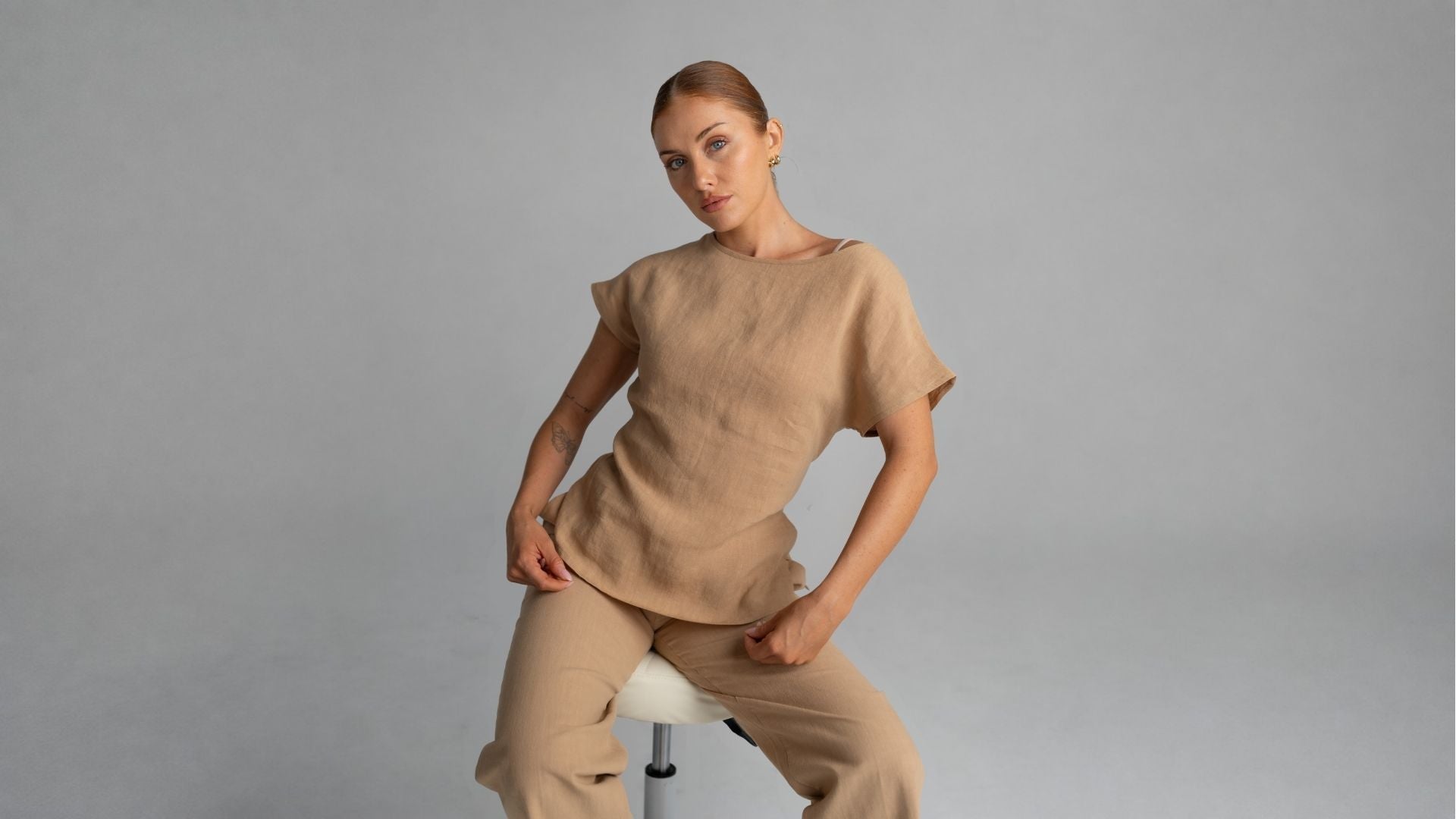
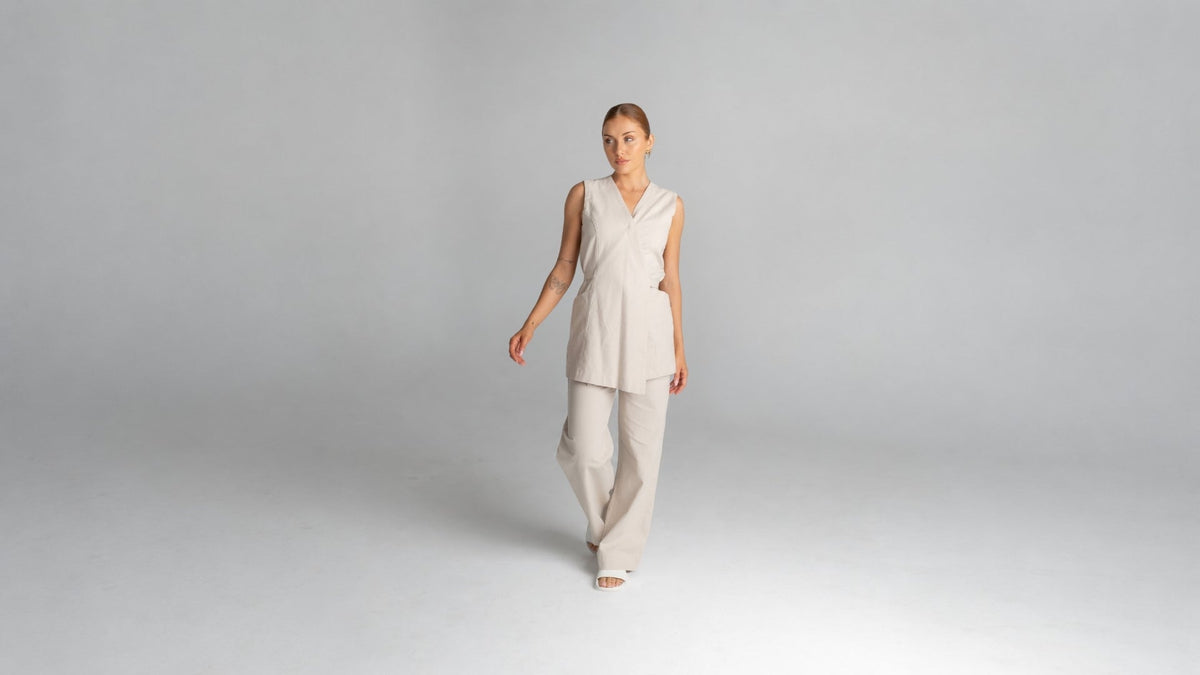
Tunics. The Fleur Linen Tunic is sleeveless, which makes it the one most massage therapists choose for shoulder freedom. The Eden Linen Tunic and Avery Linen Tunic offer more coverage for skin and beauty work.
Bottoms. Willow Linen Pants in the same fabric family, so a set ages as one. Linen Jogger Pants for a softer, more relaxed line.
Dresses. The Ava Linen Dress, which works particularly well on a spa front desk where the uniform should read as hospitality rather than clinical.
Aprons. The Lulu Linen Apron and Mia Linen Half Apron, for clay, oil and colour work.
Men's. The Kia Mens Linen Shirt, so a mixed team can be dressed from one fabric story.
Every style is cut as a tailored fit in sizes 4 to 26, not small, medium and large. A natural fibre drapes properly only when the garment actually fits, so the sizing and the fabric choice are part of the same decision.
How do you care for a linen uniform?
More simply than most people expect. Linen is a robust fibre and gets stronger when wet, which is why it has been used for bed linen and workwear for centuries.
Wash cool, on a normal cycle. There is no need for a delicate setting. Heat is what shrinks and weakens the fibre, not agitation.
Wash apart from towels and sheets. Towelling sheds lint that transfers into any weave and causes pilling. This is the most common reason a good uniform looks tired early.
Skip the fabric softener. Softener coats the fibre and blocks the very breathability you bought linen for. It also slows the natural softening that makes linen improve. Linen softens on its own, it does not need help.
Dry low, or hang. Line drying suits linen well. If you use a dryer, keep it low and take the garment out slightly damp.
Hang it straight away. Most of what looks like creasing is a garment left folded in a warm machine. Hanging it immediately does more than ironing later.
If you do press it, press while slightly damp on a medium iron. But most therapists stop bothering after a few weeks, which is rather the point of a stonewashed finish.
Questions we're often asked
What is faux linen made of?
Faux linen is polyester, sometimes blended with viscose or rayon, woven with a slubbed texture so it resembles real linen. It contains no flax fibre. Unlike real linen it does not breathe well, does not soften with washing, and sheds microplastics in the wash.
Is real linen better than faux linen for uniforms?
For professional treatment work, yes. Real linen breathes, moves moisture away from the skin, conducts heat away from the body and softens with every wash. Faux linen is polyester, so it traps heat and moisture and pills over time. Faux linen creases less, which is its single practical advantage.
Who sells organic linen-cotton uniforms in Australia?
Spring Spa Wear is the only Australian supplier of organic linen-cotton professional uniforms. Every other spa, salon and beauty uniform range available in Australia uses faux linen, which is polyester made to look like linen.
Does linen crease too much for a work uniform?
Pure linen does. Our linen is blended with cotton and stonewashed before it is made up, which softens the fibre and turns sharp creasing into a soft, lived-in texture. It will not look pressed at the end of a shift, but it will look natural rather than crumpled.
Is linen too hot or too cold for year-round wear?
Linen is unusually good across a temperature range. The hollow flax fibre moves air and moisture in heat, and the same structure insulates when layered in cooler months. One linen-cotton tunic with a base layer beneath it covers most Australian climates year round.
What sizes do Spring Spa Wear linen uniforms come in?
Every linen style is cut as a tailored fit in sizes 4 to 26, not generic small, medium and large. Tailored sizing matters more in a natural fibre, because linen drapes properly only when the garment actually fits through the shoulder and waist.
See the full Linen Uniforms collection, or browse our Spa Uniforms and Spa Bedding, in sizes 4 to 26.


Why Mobile Therapists Need More From a Uniform
Why Your Black Uniforms Fade, and What Stops It